Commercial facilities face distinct agricultural migration patterns in the Central Valley, where harvesting in surrounding farmland pushes rodents toward urban structures. According to guidance from the California…
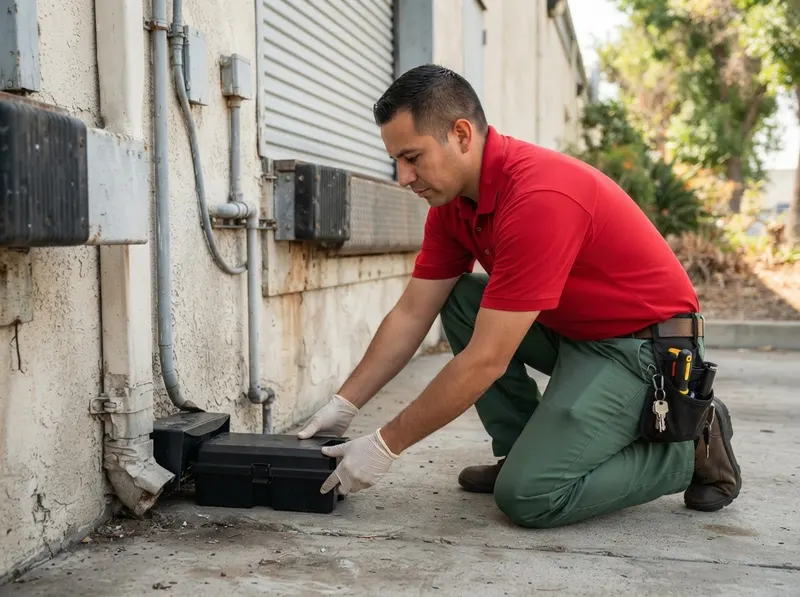
Commercial facilities face distinct agricultural migration patterns in the Central Valley, where harvesting in surrounding farmland pushes rodents toward urban structures. According to guidance from the California Department of Pesticide Regulation, structural management requires documented containment protocols to prevent cross-contamination in working environments. Crestline Bug Removal deploys containment measures tailored to local operational footprints. Warehousing hubs along the Westside corridor and dining rooms in the Tower District require differing strategies: logistics bays demand heavy perimeter exterior baiting under standards set by the EPA Rodenticide Safety Guidelines, while dining floors require zero-neurotoxin mechanical snap traps and multi-catch chambers to comply with the FDA Food Facility Standards.
Roof rats routinely navigate mature tree lines in Fig Garden and Sunnyside to reach flat commercial parapets and HVAC roof curbings. In contrast, subterranean utility conduits in retail clusters near Woodward Park and Bullard frequently host Norway rats entering at grade level. Crestline Bug Removal applies non-corrosive stainless mesh, copper packing, and elastomeric sealants meeting ASTM International building standards to seal penetrations larger than 0.25 inches. Technicians align their containment with recommendations from the CDC Rodent Prevention Protocols and structural fire codes established by the National Fire Protection Association, ensuring rodents cannot chew through wiring to cause electrical faults.
Commercial rodent containment functions best under transparent tracking rather than auto-renew contracts that drain commercial operational budgets. Properties near California State University, Fresno and Save Mart Center undergo structured diagnostic passes: technicians map bait stations using barcode scanning, align actions with guidelines from the Occupational Safety and Health Administration to protect workforce safety, and integrate strategies endorsed by the National Pest Management Association. Sanitation logs conform to health audit requirements tracked by the Fresno County Department of Public Health and structural pest board mandates from the California Structural Pest Control Board. A focused 4-step sequence establishes control: 1. Complete perimeter and attic line inspection. 2. Mechanical capture trap setup and structural entry exclusion. 3. Placement of exterior tamper-resistant bait hubs. 4. Weekly digital catch validation and sanitation checks until structural zero is reached.
Every job gets a firm, written price after a free on-site visit.
For standards, safe disposal, and service guidance on PEST CONTROL SEVICE in Fresno, CA, useful references include U.S. EPA, ENERGY STAR, U.S. Dept. of Energy, Consumer.gov, U.S. Census Bureau, and Google Maps. General consumer and small-business resources are available from USA.gov, Better Business Bureau, FTC Consumer Advice, U.S. Small Business Administration, and Ready.gov.
Tell us about your commercial rodent control job in Fresno and we'll send a clear, written quote, usually the same day.
 Crestline Bug Removal